86-0573-88960598 / Sales & Service Support
Email:fuluo@jxfuluo.com
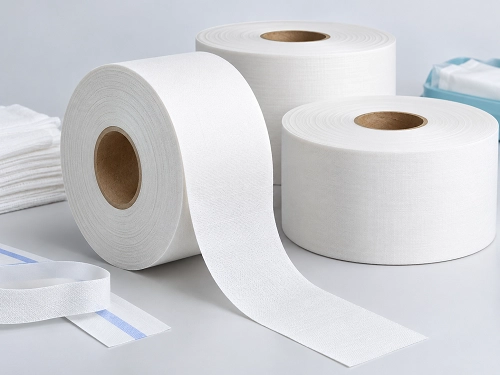
A medical tape jumbo roll is the master roll behind most tapes and dressings: a wide web of fabric, film, foam or non-woven material coated with a pressure-sensitive adhesive (PSA) and wound for slitting into finished products. Choosing the wrong one costs more than money. It shows up later as poor converting yield, early lift-off, or skin injury to the patient.
Buyers often begin with a width or a price. A faster route is to answer three questions first, because each one narrows the roll type before you compare any datasheet:
FULUO's medical roll materials are organized into six families. The table below combines the typical figures FULUO publishes in its own technical sourcing guide with the selection logic above. Treat the numbers as typical ranges; your final specification should come from a datasheet for the exact grade.
| Roll family | Typical elongation | Typical adhesive | Choose it when | Watch out for |
|---|---|---|---|---|
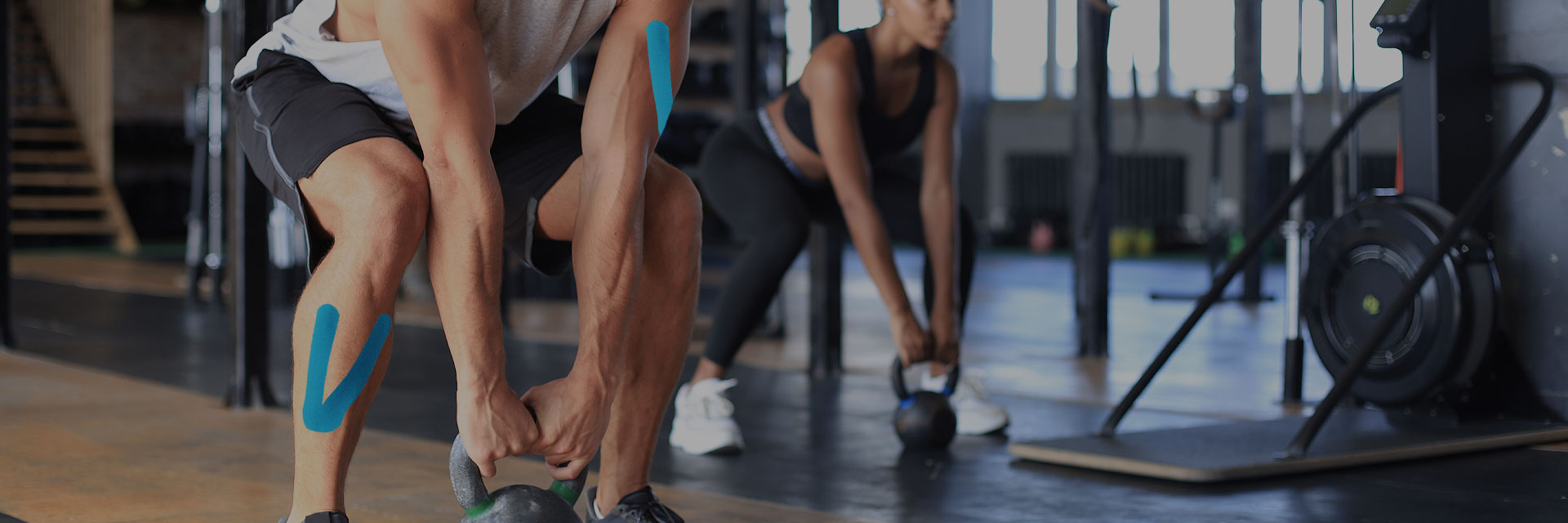
| Kinesiology tape rolls | 130–180% | Heat-activated acrylic, wave pattern | Multi-day wear on moving joints | Elongation consistency from lot to lot |
| Rigid sports tape rolls | <10% | Zinc oxide or acrylic mass | Joint immobilization and strapping | High peel strength; harder to remove |
| Elastic adhesive fabric rolls | 50–100% | Natural rubber or acrylic | Compression wrapping, elastic bandaging | Latex risk if rubber adhesive is used |
| PU film adhesive rolls | 500–700% | Acrylic, solvent or hot-melt | Waterproof dressings, IV fixation | Film thickness uniformity; moisture vapor transmission |
| Non-woven adhesive rolls | 15–30% | Acrylic emulsion | Breathable plasters, surgical dressings | Lower peel strength on sweaty or moving skin |
| PE foam electrode rolls | 20–40% | Conductive acrylic | ECG and TENS electrode attachment | Adhesive must suit the electrode design |
Figures: FULUO Medical, Medical Adhesive Jumbo Rolls: The Complete Technical & Sourcing Guide (June 25, 2026). The “Choose it when” and “Watch out for” columns are the author's practical guidance.
The backing sets how the tape moves; the adhesive sets whether it hurts to remove. The consensus guidance on medical adhesive-related skin injury (MARSI) advises choosing the least aggressive adhesive that still secures the device for its intended use, and it favors silicone adhesives where available because they tend to cause less trauma on removal than acrylate, hydrocolloid or rubber adhesives. In practice that gives a simple ladder:
The skin-injury risk is not trivial. A 2013 consensus paper in the Journal of Wound, Ostomy and Continence Nursing, Medical Adhesives and Patient Safety: State of the Science, describes MARSI as common yet under-recognized and reports an estimated 1.5 million or more US patients affected each year.
Two rolls with the same name can run very differently on your slitting line. These are the parameters worth writing into your purchase specification:
For custom widths, coat patterns, laminates or private-label liner printing, see OEM and customization. FULUO's published minimum for development quantities is 500 kg.
Regulatory status depends on the finished product and the market, so the roll supplier's job is to give you clean documentation. Three checks cover most of it:
A short check on receipt prevents most line problems. Inspect the outer wrap for crushed edges, confirm label data (lot, width, length, adhesive code) against your order, unwind the first meters to check for liner wrinkles, and run a sample peel test against your acceptance limits. Store rolls on a flat or cored-up position as the supplier directs, away from heat, direct sun and humidity, and keep them sealed until use, because adhesives and breathable substrates both change when conditions drift. Follow the shelf-life and temperature limits on the datasheet rather than a general rule.
Whether you are an OEM writing instructions for use or a clinician applying tape, the same MARSI guidance applies:
For sports use, FULUO describes typical applications on its sports page, and for dressings and fixation see surgery and personal care.
Beyond price, ask for verifiable certificates, biocompatibility data for your exact build, coat-weight specification and measurement frequency, slit-width tolerance, shelf-life data, and lead time for custom specifications. On the production side, FULUO reports two independent laboratories, more than ten full-time inspectors, three production lines, a 500 m² GMP 100,000-class workshop, 160 employees and about 4 million square meters of adhesive coating per year; details are on its Why Choose Us page. FULUO has manufactured tapes in Zhejiang since 2007 and supplies both roll materials and finished products. For a related read on upstream materials, see the medical tape raw material rolls guide.
What is the difference between a jumbo roll and a finished tape roll?
A jumbo roll is the wide master roll that is slit, die-cut and packaged into the finished tapes and dressings users handle.
Which adhesive is gentlest on sensitive skin?
Silicone adhesives are generally the gentlest on removal, followed by low-peel acrylic emulsions; confirm suitability with biocompatibility data for your specific build.
Can I order custom widths and cores?
Yes. FULUO accepts OEM specifications for width, core size, coat pattern and liner printing; contact the team to discuss your requirements.